Every CISO faces the same boardroom question: “What are we getting for our security spend?”
It is no longer enough to say your organization is “more secure.” Security leaders today must prove it in numbers, in metrics, and in measurable outcomes. That is where the ROI of managed SIEM becomes a business-critical conversation.
According to the IBM Cost of a Data Breach Report 2024, the average cost of a data breach around the world hit $4.88 million, a 10% jump from 2023 and the largest single-year increase since the pandemic. Yet organizations that deployed AI and automation extensively in their security operations saw an average of $2.2 million less in breach costs compared to those that did not.
That gap is your SIEM ROI starting point.
In this guide, you get to know about
- How to measure SIEM security visibility
- How to calculate a SIEM cost-benefit analysis
- The real-world value of managed SIEM 24/7 monitoring
- The role AI SIEM and SIEM machine learning play in maximizing that investment
What Is SIEM ROI and Why Is It Hard to Measure?
Managed SIEM ROI or Return on Security Investment (ROSI) is the quantified value your organization receives from deploying a Security Information and Event Management system relative to its total cost. Traditional ROI is about money made, but SIEM ROI is about money saved and disasters avoided. That makes it a different kind of calculation, but one that is still very achievable with the right approach.
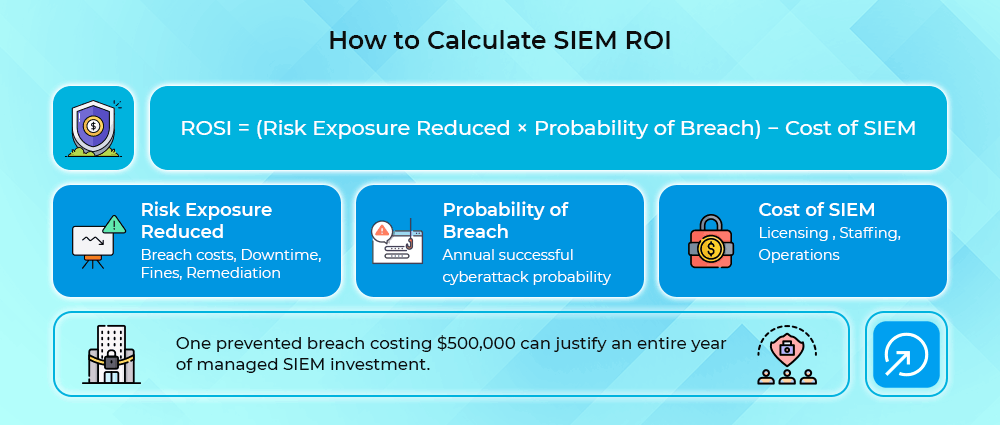
The core formula for SIEM ROI calculation looks like this:
ROSI = (Risk Exposure Reduced × Probability of Breach) − Cost of SIEM
Breaking that down:
- Risk Exposure Reduced = the financial loss you would have suffered without SIEM (breach costs, downtime, fines, remediation)
- Probability of Breach = estimated likelihood of a successful attack per year
- Cost of SIEM = total cost of ownership, including licensing, staffing, and operations
For most mid-market organizations, even a single prevented breach that would have cost $500,000 in recovery and regulatory fines can justify an entire year of managed SIEM cost.
The True Cost of Managed SIEM:
Before measuring returns, you need to understand what you are actually spending. Managed SIEM Total Cost of Ownership (TCO) goes beyond the license fee. It includes:
- Licensing and subscription fees: Most enterprise SIEM platforms are priced by data volume (GB/day) or by event volume (EPS: Events Per Second)
- Infrastructure costs: Storage, compute, and network bandwidth for log ingestion
- Staffing and analyst time: In-house SIEM typically requires 2–4 dedicated analysts to tune rules, investigate alerts, and maintain integrations
- Integration and deployment: Initial SIEM implementation cost includes professional services, log source onboarding, and custom rule development
- Ongoing tuning and maintenance: Rules must be updated as your environment evolves and new threats emerge
This is exactly where the in-house SIEM vs managed SIEM debate becomes financially significant. When you factor in analyst salaries (averaging $95,000–$120,000 per year in the US), benefits, training, and attrition, the SIEM vs in-house SOC cost comparison often tilts decisively toward a managed service.
SOC as a service pricing for managed SIEM typically ranges from $5,000 to $25,000+ per month, depending on data volume, number of log sources, and SLA requirements, often less than the fully-loaded cost of a single senior security analyst.
Key SIEM Metrics That Prove Business Value
The strongest way to demonstrate managed SIEM ROI is through measurable security metrics. Here is what you should be measuring:
1. Mean Time to Detect (MTTD)
SIEM incident response time starts with how fast you find threats. Mean Time to Detect (MTTD) measures the gap between when an attacker enters your environment and when your team identifies the intrusion.
IBM’s 2024 data shows that organizations detecting breaches internally shortened their breach lifecycle by 61 days and saved nearly $1 million compared to those who discovered breaches through external notification. A managed SIEM with AI-powered detection directly compresses your MTTD.
2. Mean Time to Respond (MTTR)
Once a threat is found, how fast you respond decides how much damage is done. According to Huntress reports, cutting response time through automated detection reduces downtime and remediation costs, directly improving your SIEM ROI. CrowdStrike’s 2024 Threat Hunting Report found that the average attacker can move through your systems in just 48 minutes, which means your response time needs to be measured in minutes, not hours.”
3. Managing False Alerts and Alert Overload
Too many alerts in SIEM is one of the most underappreciated killers of security ROI. When analysts spend 60 – 70% of their time chasing false alarms, real threats slip through, and analyst burnout spikes. Reducing SIEM false positives is not just a quality-of-life improvement; it is a financial one.
This is where AI SIEM and SIEM machine learning deliver measurable, quantifiable impact.
4. Log Source Coverage and SIEM Security Visibility
Our SIEM is only as good as the data it receives. The more systems connected to it, the better your visibility. Gaps in log coverage create blind spots that attackers can take advantage of. Measuring how well your endpoints, cloud systems, identity platforms, and network devices are covered gives you a score you can track and improve over time.
5. MITRE ATT&CK Coverage
Checking your SIEM coverage against the MITRE ATT&CK framework gives you a clear picture of your detection strengths and weaknesses. It is an easy way to show executives and auditors which threats you are covered for and which ones you are not, making your cost-benefit analysis much more credible and specific.
AI SIEM and Machine Learning: The Biggest ROI Multiplier
If there is one factor that has changed the ROI of managed SIEM calculation most dramatically in recent years, it is the integration of artificial intelligence and machine learning.
According to Elastic’s 2025 SIEM Landscape guide, AI in SIEM makes threat detection faster by pulling together security data from across your environment, identifying suspicious patterns, and helping analysts jump straight to the incidents that matter most. It also reduces alert fatigue by filtering out false alarms based on risk and historical behavior.
Gurucul’s research on SIEM machine learning ROI confirms that machine learning SIEM systems can dramatically improve the accuracy of threat detection while lowering the costs of chasing fake alerts and doing things manually. This enables security teams to focus skilled analyst time on genuine incidents rather than noise.
The IBM 2025 Cost of a Data Breach Report reinforces this: organizations using AI tools extensively cut their breach lifecycle by 80 days and saved nearly $1.9 million on average compared to those without AI-powered security.
Key capabilities of AI SIEM that drive ROI include:
- Behavioral baselining: ML models learn what normal looks like for each user, device, and application, flagging deviations that static rules would miss.
- Unsupervised anomaly detection: Detects insider threats and compromised accounts without needing pre-set rules or known attack patterns.
- Intelligent Alert Management: AI prioritizes alerts for your team so the most dangerous incidents get attention first.
- Predictive analytics: Modern AI SIEM platforms can forecast potential attack vectors before they materialize.
- MITRE ATT&CK mapping automation: AI continuously maps detected behaviors to attack techniques, closing SIEM MITRE ATT&CK coverage gaps in near real time.
In-House SIEM vs Managed SIEM:
The in-house SIEM vs managed SIEM decision is fundamentally a SIEM cost-benefit analysis exercise. Here is how the comparison typically breaks down:
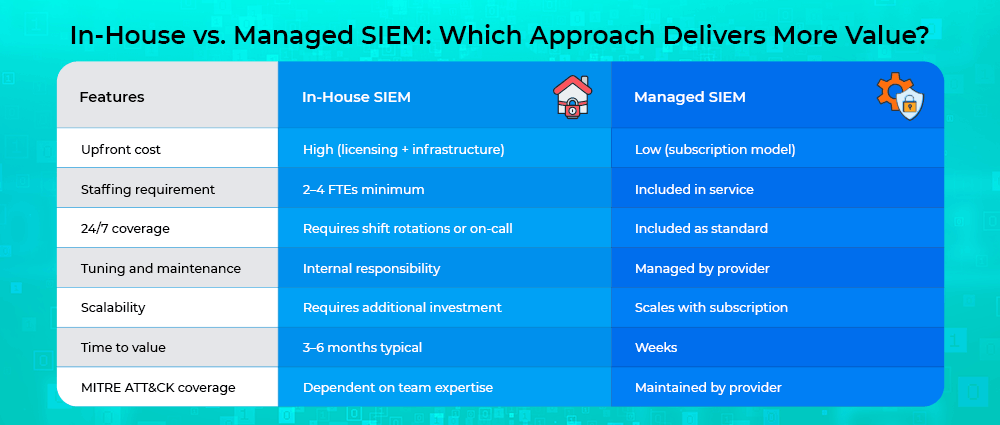
For most organizations without a large, mature security operations team, managed SIEM 24/7 monitoring delivers faster time to value, lower TCO, and more consistent SIEM threat detection effectiveness than attempting to build it in-house.
The key caveat: not all managed SIEM providers are equal. Evaluate providers on their detection coverage (mapped to MITRE ATT&CK), MTTD/MTTR SLAs, false positive rates, and transparency of reporting.
Building Your SIEM ROI Business Case
To build a compelling SIEM cost benefit analysis for leadership, structure your argument around four pillars:
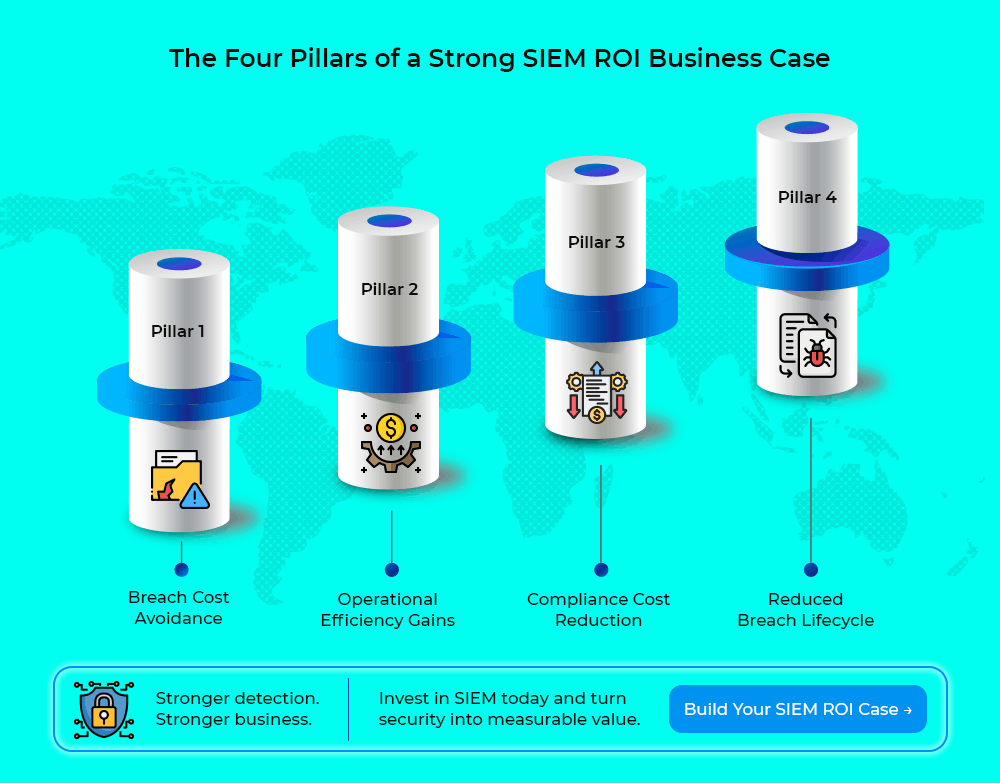
Pillar 1: Breach Cost Avoidance
Use industry benchmarks as your baseline. With data breaches costing millions on average and your industry’s specific risk level, calculate how much your organization could lose in a year without a strong detection capability. Even a 20% reduction in breach probability translates into millions in avoided losses.
Pillar 2: Operational Efficiency Gains
Measure the time saved through automation and faster investigations. If your team spends 30 hours a week chasing false alarms and your AI SIEM cuts that by 60%, that’s 18 hours a week freed up time your team can spend on real security work.
Pillar 3: Compliance Cost Reduction
A well-configured SIEM with complete SIEM log source coverage and automated reporting significantly reduces the cost of compliance audits for frameworks like PCI-DSS, HIPAA, ISO 27001, and SOC 2. Manual evidence collection that takes weeks can be reduced to an automated report generation.
Pillar 4: Reduced Breach Lifecycle
Every day you detect and contain a threat faster saves your organization real money. Without AI-powered detection, it takes an average of 194 days to spot a breach and another 64 days to stop it. Organizations using mature AI SIEM have cut that timeline by nearly 100 days, directly reducing breach costs.
SIEM Metrics Dashboard: What to Report to Leadership
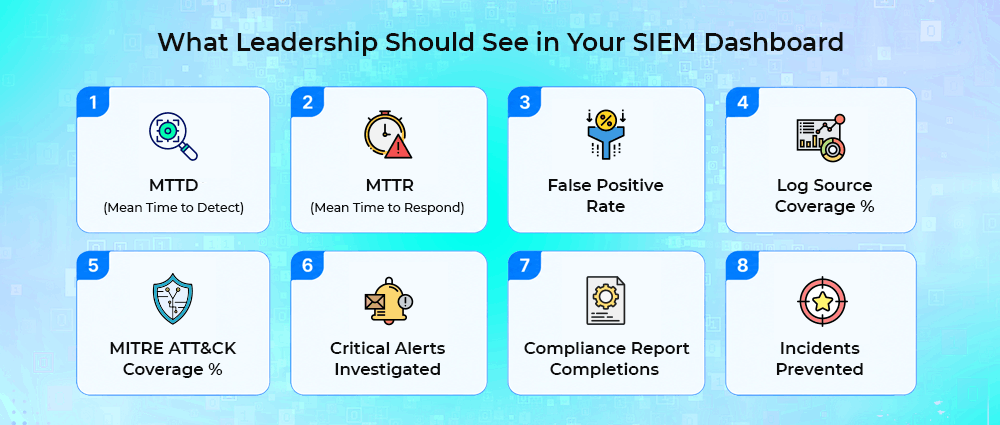
For ongoing Managed SIEM ROI reporting, track and present these metrics monthly:
- MTTD (Mean Time to Detect): trending over time.
- MTTR (Mean Time to Respond): by severity category.
- False Positive Rate: and month-over-month improvement.
- Log Source Coverage %: systems monitored vs total in environment.
- MITRE ATT&CK Coverage %: detection rules mapped to ATT&CK techniques.
- Critical Alerts Investigated: total vs closed within SLA.
- Compliance Report Completions: automated vs manual.
- Incidents Prevented: estimated based on threat intelligence correlation.
Present these in a consistent format each month, and your return on security investment (ROSI) becomes a narrative that improves over time, not a one-time justification exercise.
Conclusion:
Security leaders who treat SIEM as a cost center will always struggle to justify the investment. Those who treat it as a risk management and operational efficiency platform and measure it accordingly consistently demonstrate positive returns.
The data is clear. Faster detection saves millions. Reduced false positives to free up analyst capacity. AI SIEM and SIEM machine learning compress threat lifecycles in ways that manual monitoring simply cannot match. Managed SIEM 24/7 monitoring delivers enterprise-grade visibility at a fraction of the cost of building an equivalent in-house capability.
Your SIEM is not just a security tool. It is your most measurable defense investment. Build the metrics framework, track the right KPIs, and let the numbers make the case for you. Let’s ensure your SIEM investment delivers measurable ROI, with the expert team here at Amsat.
Frequently Asked Questions